Say you have always wanted to learn some Spanish, or chess, or a few chords on the piano. Most courses expect an hour a day. You have about 15 minutes after the dishes.
Start with the time you have
A free AI tool can build a learning plan around your real schedule. Tell it your level, your goal and how many minutes you have. You might type:
I want to learn conversational Spanish. I have zero experience. I can practise 15 minutes a day for the next 30 days. Create a daily plan that teaches me enough to get by at a restaurant and in a taxi. Start simple. Build on each day.
You get a plan for Day 1 through Day 30, with each day building on the last. The time limit does the work. When you say “15 minutes a day”, AI has to pick what matters most and leave the rest for later.
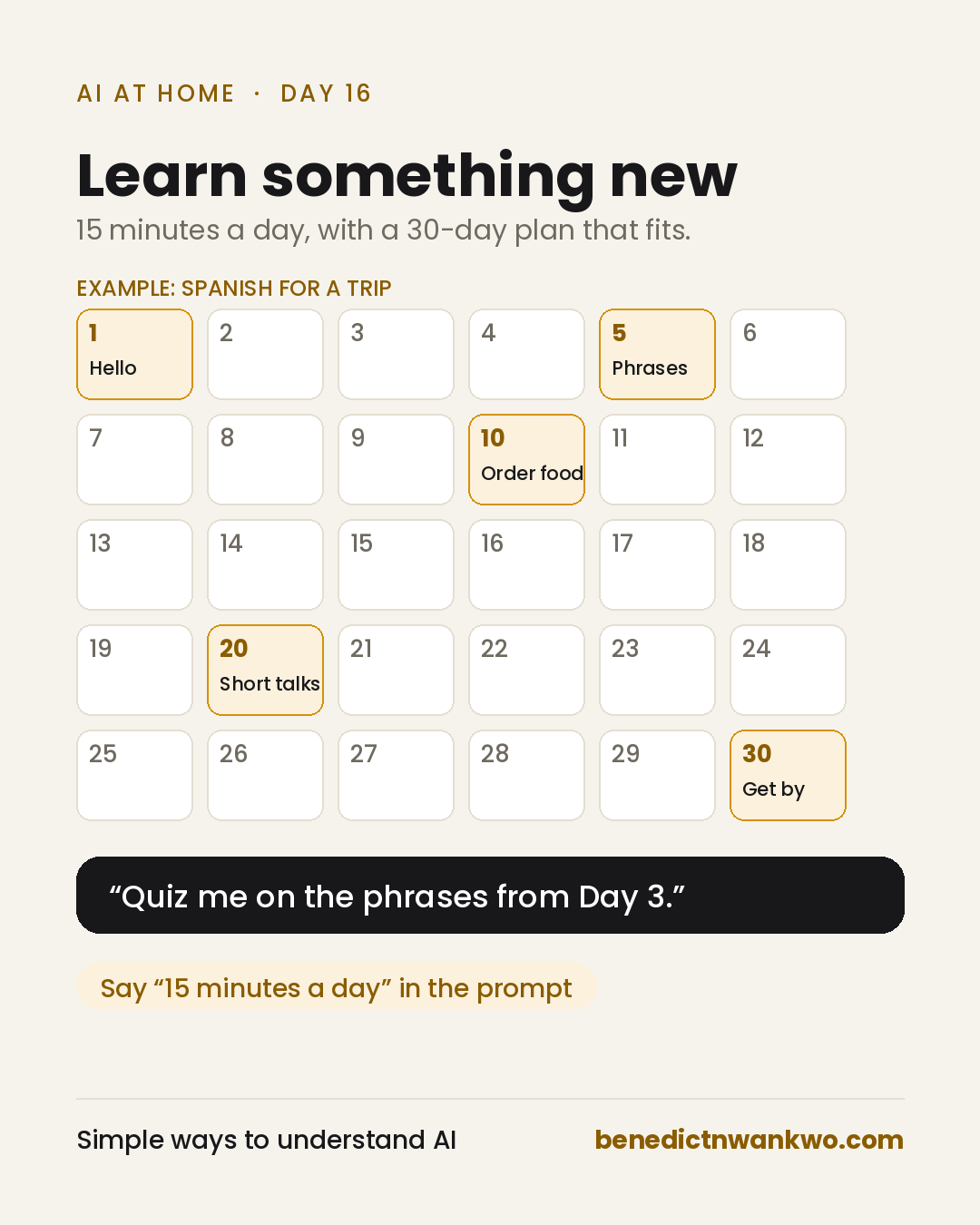
Use AI as a practice partner
Once you have the plan, ask AI to practise with you:
Have a simple conversation with me in Spanish. I am a beginner. Correct my mistakes gently and explain why.
AI can make mistakes, so check new words in a dictionary or a free app. If a lesson moves too fast, ask it to slow down or repeat a day. Free tools that pair well with AI include Duolingo for languages, Lichess for chess and the Musictheory.net website for music theory.
Try it this week
I want to learn [skill]. My level: [beginner, some experience or intermediate]. I can practise [number] minutes a day for [number] weeks. My goal: [what you want to do]. Make a daily plan where each day builds on the one before.
On Day 0, my daughter would not let one Chinese word go until someone checked. That kind of curiosity works at any age.
What have you always wanted to learn?
Yesterday was getting ready for a doctor’s visit (opens in a new tab). Day 17: your child’s math homework, with a method you have never seen.
The Spanish example is a constructed scenario. How this was made: AI helped in formatting. See the AI use and editorial policy (opens in a new tab).