You have two good options and can’t pick one. It might be two apartments or two used cars. You think about it every day, but the pros and cons stay tangled in your head.
Put both options side by side
Give AI the facts about each option and what matters to you, and it lays them out together.
Say you are choosing between two apartments. You might type:
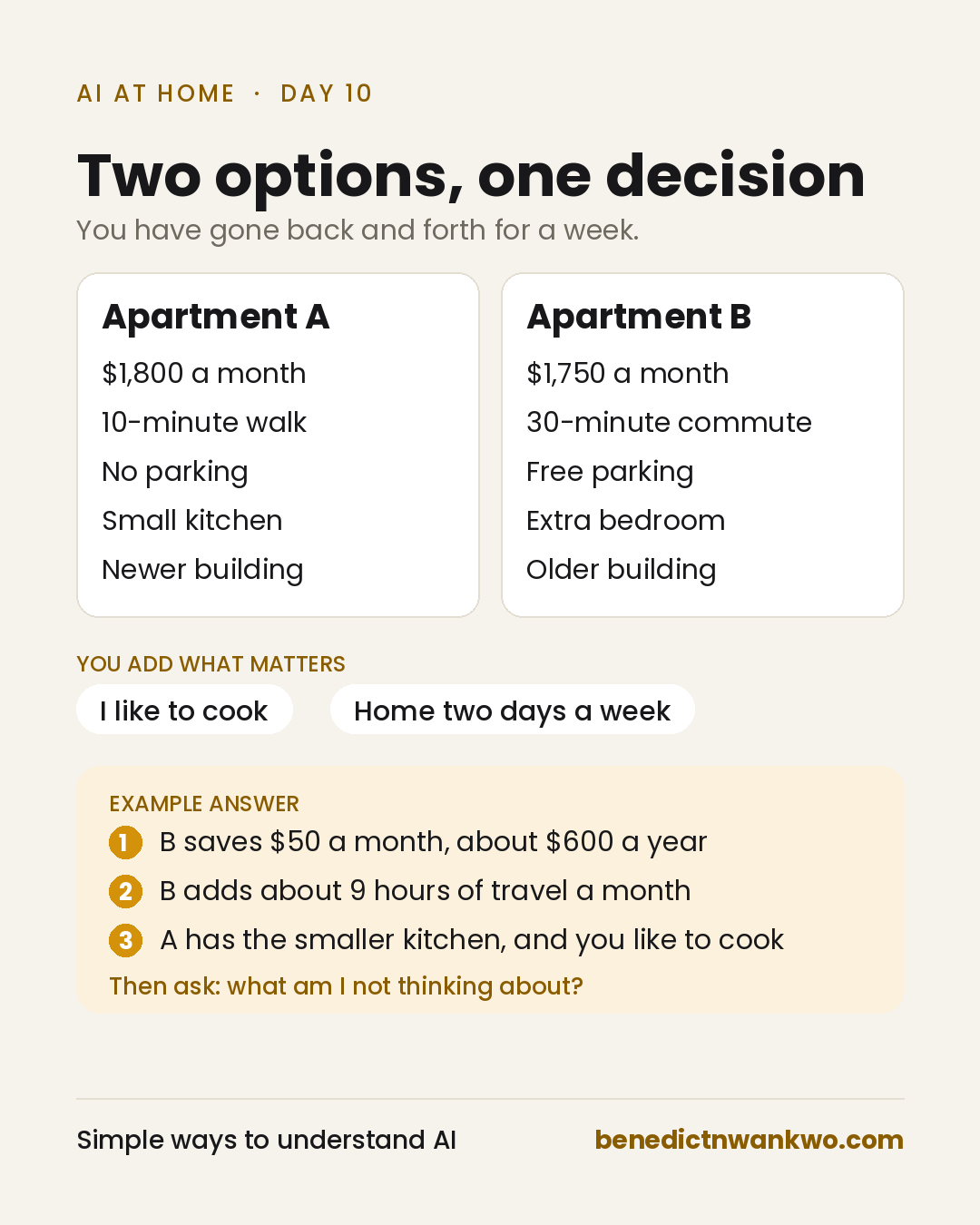
I am choosing between two apartments. Apartment A: $1,800/month, 10-minute walk to work, no parking, small kitchen, newer building. Apartment B: $1,750/month, 30-minute commute, free parking, extra bedroom, older building. I work from home two days a week and I like to cook. Compare them for my situation.
B saves $50 a month, which comes to $600 a year. With three office days a week, it also adds about 40 minutes of travel a day compared with the walk, or roughly 9 hours a month. Because you cook, the kitchen counts for more. The extra bedroom could become an office for your days at home.
Ask the curious question
Then ask one more thing, the way a curious child would:
What am I not thinking about?
It might bring up heating in an older building or where your guests will park. One of its ideas might change your mind.
What stays with you
Your priorities make the answer useful. “I like to cook” turned the kitchen from a footnote into a real factor. Check any numbers AI gives you, and see the place before you sign.
Try it this week
I am choosing between [option A] and [option B]. Option A: [4 or 5 key facts]. Option B: [4 or 5 key facts]. What matters most to me: [your top 2 or 3 priorities]. Compare them side by side for my situation. Then tell me which one fits me better and why.
What are the two options you have been stuck between?
Yesterday was your resume past the blank page (opens in a new tab). Day 11: turning your bank statement into a budget (opens in a new tab).
The apartment example is a constructed scenario. How this was made: AI helped in formatting. See the AI use and editorial policy (opens in a new tab).