The robot vacuum costs $400, and the reviews are split. Half the buyers love it. The other half say it gets stuck under the couch and gives up. You have read 30 reviews and watched four videos, and you still can’t decide.
Ask for your situation
AI can lay out a big purchase so you can think it through. The trick is to tell it about your life, then ask it to compare the options against that.
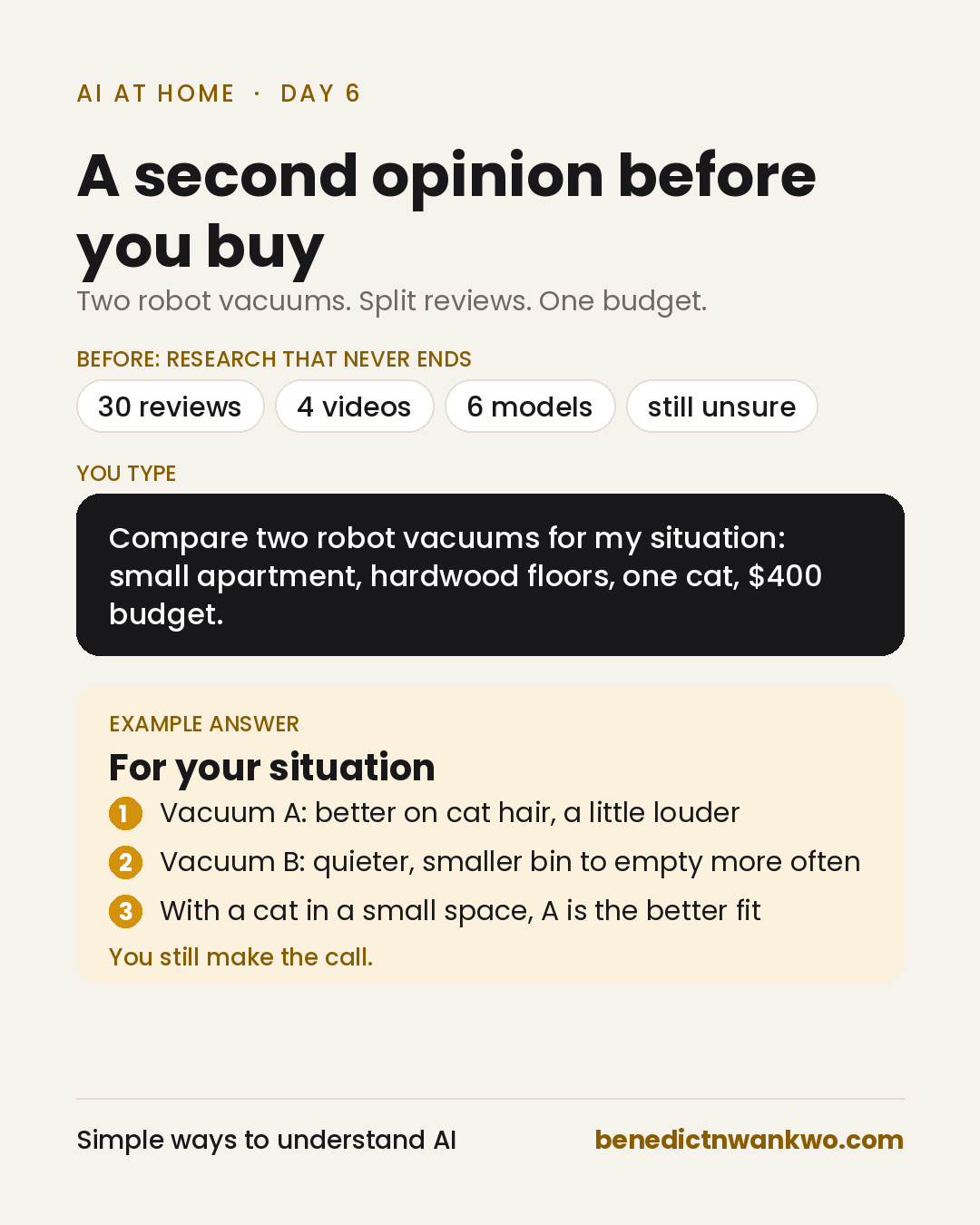
Say you are choosing between two robot vacuums. You might type:
Compare Vacuum A and Vacuum B. I have a small apartment with hardwood floors and one cat. My budget is $400. Give me pros and cons for my situation, not general features.
The words “for my situation” matter most. Instead of listing every feature, AI focuses on what fits your home: hardwood floors and cat hair in a small space, on your budget. You get a side-by-side comparison in about a minute.
What stays with you
AI can get reviews wrong or mix up two models with similar names. It may not know today’s price or what is in stock. Use the comparison to see your own priorities more clearly, then read a few real reviews and check the retailer’s site before you pay. The decision is yours.
Try it tonight
Fill in this prompt with the purchase you keep going back and forth on:
Compare [Product A] and [Product B]. My situation: [your space, budget and how you will use it]. What matters most to me: [your top two or three priorities]. Give me pros and cons for each, then tell me which one you would pick and why.
For a bigger purchase, add one more question:
What are the most common complaints from people who returned this?
Treat the answer as a list of things to look for in real reviews, and confirm them there.
What is the purchase you have been putting off?
Yesterday was the messy list, sorted (opens in a new tab). Day 7: the Week 1 check-in (opens in a new tab).
The vacuum example is a constructed scenario. How this was made: AI helped in formatting. See the AI use and editorial policy (opens in a new tab).