Say it is Saturday morning, the leaves have turned, and you want to get out of the city for a day. Nothing fancy, somewhere within two hours that isn’t your couch.
So you open a search engine, then a travel site, then Instagram, then a forum thread and a blog from 2019. Two hours later you have 14 tabs open and no plan, and the day is half gone.
Ask for a shortlist
A day trip needs a shortlist, and AI can build one fast. Open a free AI tool, like ChatGPT, Gemini or Claude, and try:
Suggest three day trips within two hours of Ottawa for a family of four. Budget under $150. We like easy hikes and fall colours. It is mid-October.
In about 30 seconds you have three options, with towns and trails you can look up, instead of a 47-page guide.
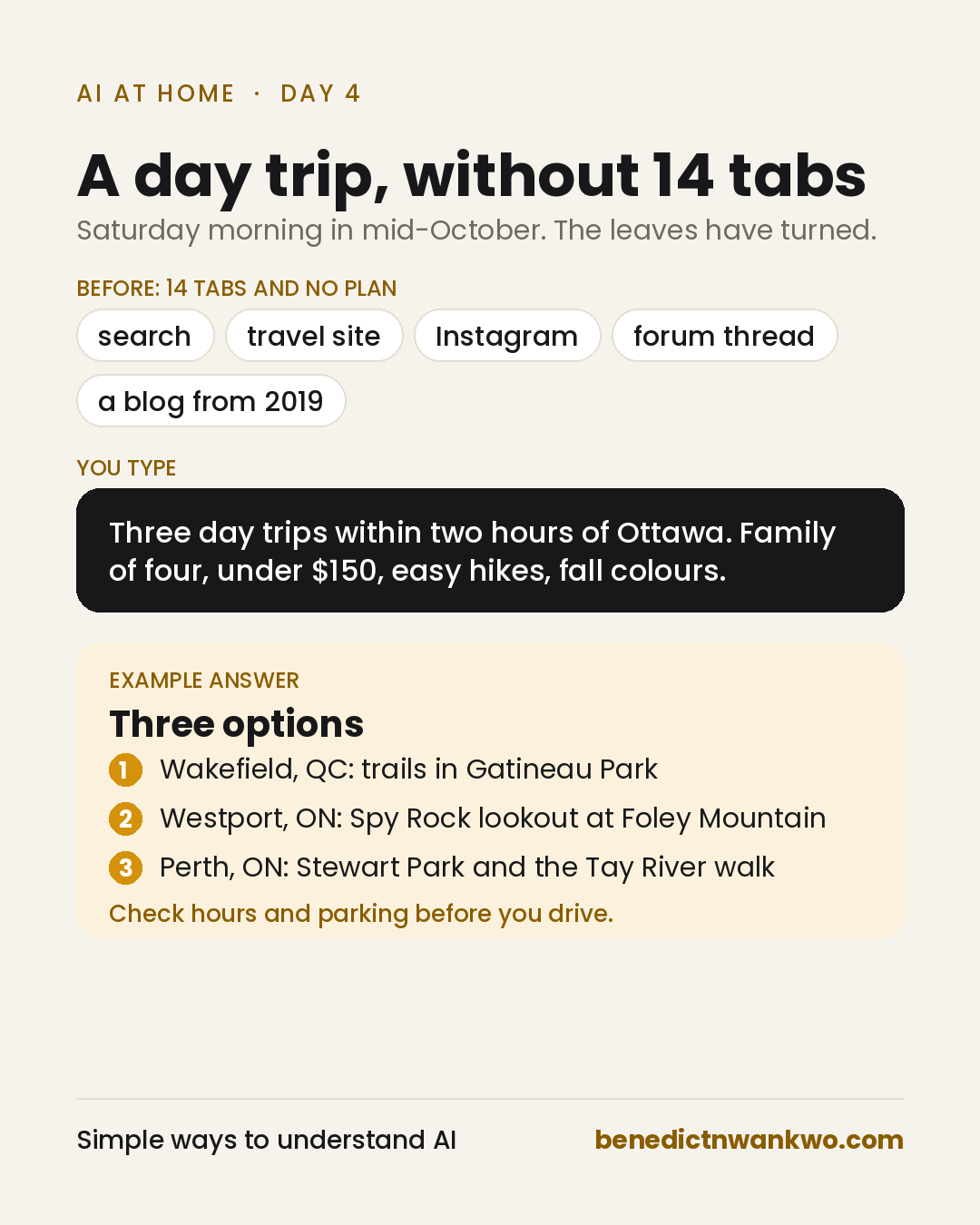
The trick is saying what matters to you. Give it your budget and how far you’ll drive, then add who is coming and what you like to do. The more of that you include, the less generic the answer.
Narrow it down
If one option catches your eye, go deeper: “Tell me more about option 2. Is there parking near the trail, and where can we get lunch?” AI works well when you start broad and narrow down.
Check before you drive
Some details will be out of date. A café may have closed for the season, or a trail may need a parking pass. Treat the answer as your shortlist and confirm the two or three things that matter before you leave.
Try it this weekend
Suggest 3 day trips within [distance] of [your city] for [who is going]. Budget under [amount]. We enjoy [what you like]. It is [month]. For each one, give me the town, one thing to do and a rough cost.
If you like one, follow up: “Plan a relaxed Saturday for option [number]. Include the drive time and somewhere to eat lunch.”
What trip have you been meaning to plan and keep putting off?
Yesterday was why the sky is blue (opens in a new tab). Day 5: the messy list in your head, sorted in two minutes (opens in a new tab).
The three day trips on the card are an example answer, not a recommendation. How this was made: AI helped in formatting. See the AI use and editorial policy (opens in a new tab).